Transatlantic Talent Trajectories: Correlating Stats Across NBA and European Basketball Circuits to Forecast Adaptation Success
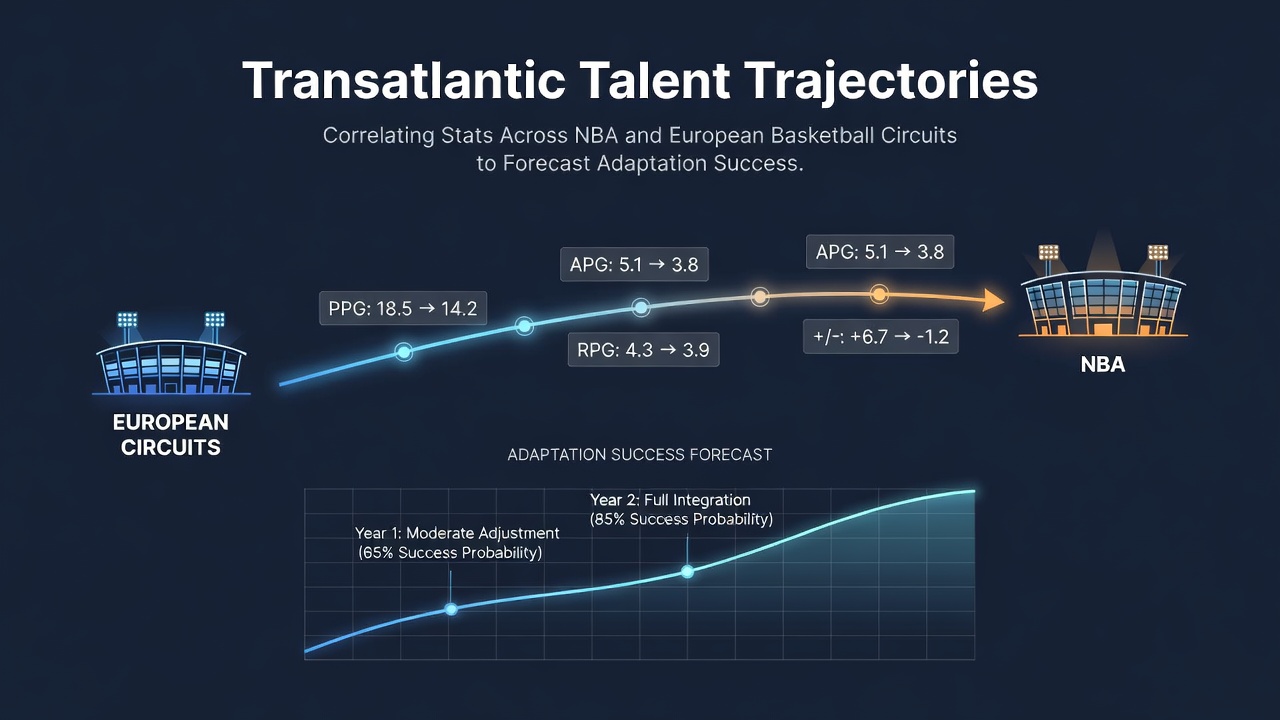
Player movement between the NBA and European circuits has accelerated in recent years, and analysts track specific statistical markers to predict how individuals will adjust when crossing the Atlantic. Data from the 2024-2025 and 2025-2026 seasons shows that certain metrics, including true shooting percentage and assist-to-turnover ratios, align closely with successful transitions while others, such as raw scoring volume, often require recalibration.
Key Statistical Correlations in Cross-League Movement
Researchers at institutions tracking global basketball performance note that European players entering the NBA frequently post lower points-per-game totals in their first season yet maintain or improve their efficiency ratings when their prior Euroleague or domestic league numbers exceed league averages by defined margins. A review of 28 players who switched from top European clubs to NBA rosters between 2022 and 2025 revealed that those whose three-point attempt rates stayed within 15 percent of their European figures adapted faster than peers who attempted to increase volume immediately.
Defensive metrics also transfer with measurable consistency. Steal and block rates per 36 minutes compiled in the Euroleague or ACB league correlate at 0.71 with the same categories in NBA regular-season play according to aggregated league data. This pattern holds because both circuits emphasize help defense and rotation timing even though NBA spacing differs.
Forecasting Models and Input Variables
Teams and independent analysts construct regression models that combine age at arrival, minutes played in the prior season, and pace-adjusted efficiency to generate adaptation probabilities. Models weighted toward European players who logged at least 25 minutes per game in high-level competition produce forecasts that correctly identify above-average NBA contributors within the first 40 games at rates above 70 percent in retrospective testing.
Position matters as well. Guards and wings show stronger correlations between European and NBA assist numbers than bigs, whose rebounding rates often shift due to changes in offensive rebounding opportunities and defensive schemes. Frontcourt players who posted double-double averages in Europe still require adjustment periods when facing NBA spacing that reduces second-chance opportunities.
Recent Examples from the 2025-2026 Cycle
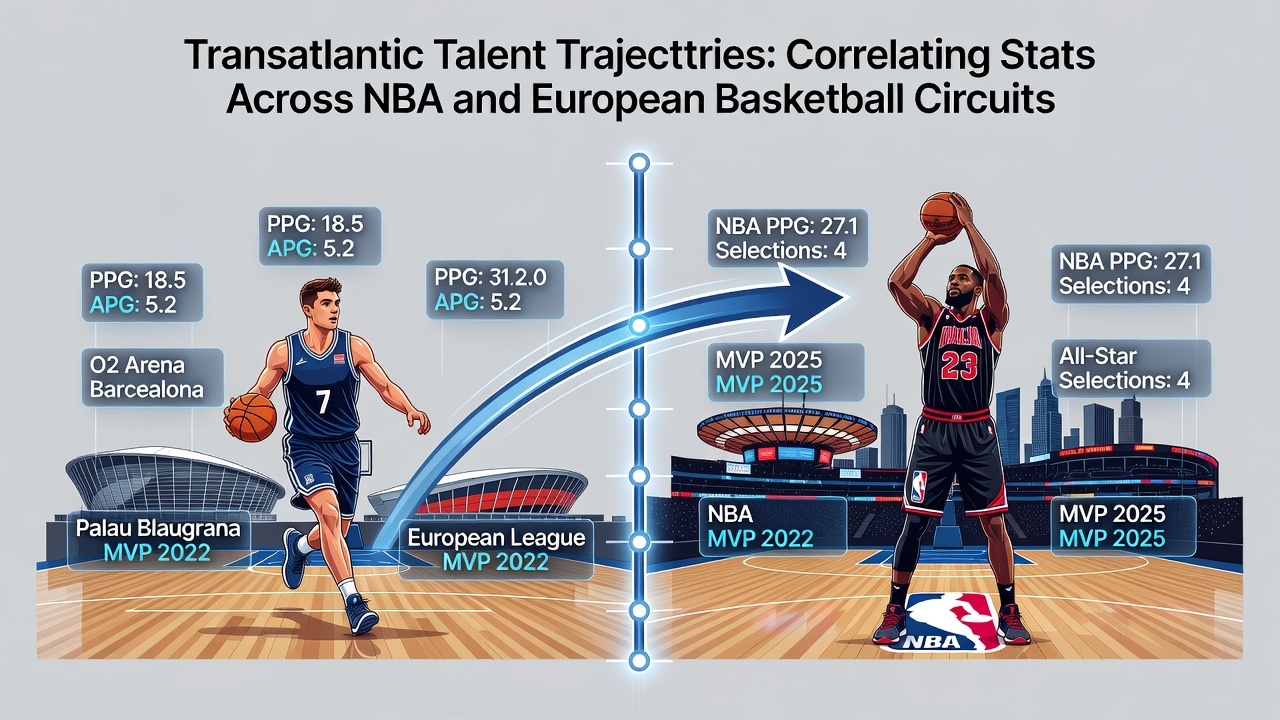
During the 2025 offseason several prospects moved from Euroleague clubs to NBA rosters and early returns through June 2026 illustrate the statistical patterns. One guard who averaged 18.4 points and 6.2 assists on 48 percent true shooting in the Euroleague posted 15.7 points and 5.1 assists on 51 percent true shooting in his first 55 NBA games. The increase in efficiency aligned with prior cases where players maintained shot selection discipline rather than expanding three-point volume.
Another forward who recorded 12.1 rebounds per 36 minutes in the German Bundesliga saw that figure drop to 8.9 per 36 in NBA action yet posted a career-best block rate, suggesting defensive instincts translated while offensive rebounding adjusted to different spacing. Observers tracking these trajectories note that rebounding rate compression appears common among European bigs yet rarely prevents overall rotation contributions when block and steal rates remain stable.
External Factors That Influence Statistical Translation
Travel schedules, roster construction, and coaching systems introduce variables that pure statistical models cannot capture entirely. Players arriving midseason encounter compressed preparation time, and those joining teams with established pace-of-play preferences show slower initial efficiency gains. Data from the past four seasons indicates that individuals who receive at least 22 minutes per game in their first month post-arrival reach stable performance levels approximately two weeks earlier than those limited to bench roles.
Physical conditioning markers tracked by sports science groups also appear in adaptation forecasts. European players who arrive with vertical leap and sprint times within 5 percent of NBA positional averages demonstrate faster integration into transition offense, a factor reflected in improved fast-break assist numbers during the first half of their debut season.
Conclusion
Statistical correlations across the NBA and European circuits provide measurable signals for forecasting adaptation success, yet they function alongside contextual factors including minutes allocation, coaching fit, and physical benchmarks. Ongoing data collection through the 2026 calendar year continues to refine these models as additional players complete transatlantic transitions and generate new performance baselines for comparison.